
Hidden history found in quiet Milton Keynes village inspires new musical about Bletchley Park
Loughton residents have discovered codebreakers on their doorstep as an exciting new Bletchley Park musical prepares to launch next month.
They have learned that key figures in the breaking of the Enigma code once lived on their streets leading ordinary, low-key lives between carrying out their historic work.
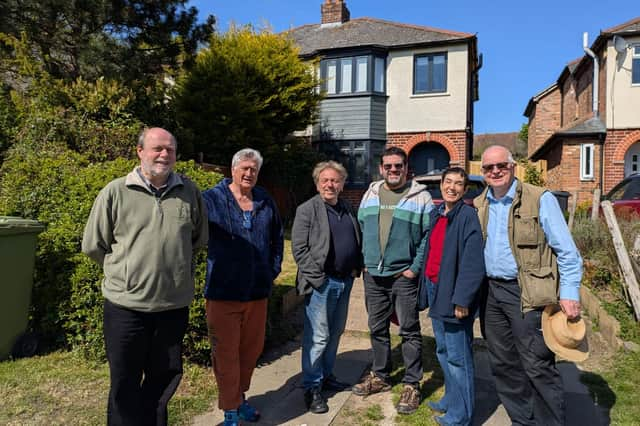

Local writer Mike Cashman has been researching the lives of wartime codebreakers who were based in the area in order to write his musical about the famous wartime activities at Bletchley Park.
He has identified both the house where mathematician Gordon Welchman lived for a time, and the nearby home where codebreaker Betty Webb was billeted.
Welchman, one of the key figures in making the Bombe codebreaking machines operational, lived in Loughton with his wife and son during the early years of the Second World War, according to his biography by Joel Greenberg.
Webb, who went on to have a long career connected with Bletchley Park, was among many young recruits housed locally while working in complete secrecy.
“These weren’t remote figures working in isolation,” said Mike. “They were living ordinary lives in places like Loughton — walking these streets, meeting people, and then going into Bletchley Park to do extraordinary work.”
The research has fed directly into “Dons, Wrens and Bombes", a musical telling the story of the people and ideas behind the breaking of Enigma. The project has now completed a major phase, with all 33 songs recorded over three intensive days in home studios in Milton Keynes and Buckinghamshire.
The recordings will be professionally mixed and mastered ahead of the musical’s launch at The National Museum of Computing at Bletchley Park on Saturday 30 May, where audiences will be able to hear excerpts and take part in interactive activity related to the Musical.
Mike Cashman recently presented the material both to a local Loughton audience and at Trinity College, Cambridge, where participants worked in small groups to explore the scale of the Enigma problem themselves.
“It’s been fascinating to see people realise just how complex the problem was,” he said. “And then how a small number of key insights made it solvable.”
The project aims to present a historically and technically accurate account of codebreaking of Enigma, focusing not just on famous names but on the wider team — including the Wrens who operated the machines and the many recruits drawn from across Britain.
The accompanying book and recording will be released at the end of May. Further details about the project can be found via the Cipher Musicals YouTube channel and Facebook page.
The musical will be launched at The National Museum of Computing in Bletchley on the morning of Saturday 30 May. It explores not only intellectual brilliance but emotional courage: the discipline of secrecy, the weight of responsibility, and the collective intelligence that made success possible.
The launch event will combine narrative storytelling with performed mini-excerpts (spoken and patter-sung), demonstrating how historical material is translated into stage form.
And the presentation will conclude with an immersive response experience, inviting the audience to engage actively with staging, musical and educational questions arising from the work.