
Cancer survivor continues fight to stop Milton Keynes council using 'toxic' weedkillers with proven links to tumours
A cancer survivor determined to rid the city of toxic chemical pesticides has urged the council to take heed of the health risks of spraying weedkiller in public areas.
Judith Heinemann is a member of Pesticide Free Milton Keynes Action Group and started a petition on change.org to ban the use of the chemicals totally in the city.
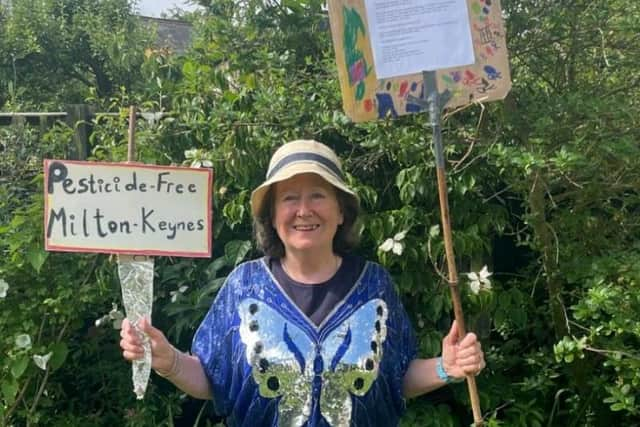

So far the petition has more than 26,000 signatures.
Judith, a parish councillor, believes traces of pesticides in the local environment may have contributed to her husband's death and her own battle with cancer. The couple were huge nature lovers and spent much of their time outdoors.
"I can't say that the causal link can be proven definitively but the evidence on this chemical toxic cocktail that we're faced with on a daily basis in our environment is that it has to stop,” she said.
The most commonly used pesticide, Roundup, is harmful to bees and butterflies, damages soil health, and is strongly suspected of causing non-Hodgkin's Lymphoma and neurological disorders such as Parkinson’s disease in humans.
It is also associated to developmental and endocrine issues, and particularly affects children and the elderly.
This week Pesticide Free MK has welcomed the council’s new Pesticide Policy, which was presented to the Environment Scrutiny Committee.
But members say the policy, while aiming to reduce and monitor the use of such chemicals, does not go far enough to counteract the risks to human health, with “hardly any mention at all” of the link between cancer and herbicides.
Also, the policy does not ban pesticides from being used in the city’s schools, children’s playgrounds and housing estates.
Our biggest concerns continue to be that MKCC doesn’t include the risks to human health of using weedkiller, that the spraying tractors will still be seen in our residential estates, that there will still be spraying in MKCC managed playgrounds and that the 115 MK schools are not included in the new policy,” said Judith.
"We recommend that mini tractors with low drift nozzles are not deployed in our residential estates. They are designed for spraying of large areas and have no place near our homes,”
She added: “We recommend that the policy specifies no spraying at all in your parks and playgrounds. Children and pregnant women are the most vulnerable to toxic load and the precautionary principle should be applied for their health and safely.”
For the same reason, the chemicals should be banned in every city school, she said.
“There is simply no need to spray poisons in our streets, verges, parks and schools where they risk harming our residents, their dogs and children in particular, bees, butterflies and other wildlife, and running off into our waterways. Safe and sustainable alternatives for weed control are available...”
Elsewhere, some countries and many cities have already banned urban pesticide use to help protect insects and human health. France banned all use of pesticides in public spaces in 2017 and, in Canada, 170 cities and towns are pesticide-free.
More than 100 towns the UK have either phased-out their use or taken significant steps to reduce usage.
Judith said: “Ending pesticide use in Milton Keynes is an achievable goal that would be a massive win for the health of both our residents, pets and wildlife.”
You can view her petition here.