
Any Questions? comes to Milton Keynes: An audience member’s perspective
The world’s longest-running political debate show Any Questions?, was broadcast from the Open University in Milton Keynes on Friday August 8.
I was among an audience of around 150 people for the live broadcast, which came from the campus’ Berrill Theatre.
It was an interesting evening of thought-provoking and sometimes lively debate, as well as the opportunity to see behind the scenes of the BBC radio programme, broadcast 50 weeks of the year on BBC Radio Four at 8pm on Friday evenings.
The political views started coming before I even entered the building, as outside in the car park a person attempted to hand out leaflets to incoming audience members on behalf of the Milton Keynes Democracy & Anti-Corruption Team, calling for a proportional representation voting system.

Once we entered the building, bag and body searches took place, although this appeared more straightforward than some security operations, as I overheard one security member saying “this is much better than Antiques Roadshow when we had to do this for the whole day.”
Once inside, audience members were invited to complete question cards with suggestions for questions that could be posed to the panel of politicians.
Information on the back of the cards advised that great questions were topical, reflected the area and sparked a great discussion.
With these pointers in mind, I submitted a question regarding the petition that has been started calling for the possible early release from jail of the killers of Thames Valley Police officer Andrew Harper.
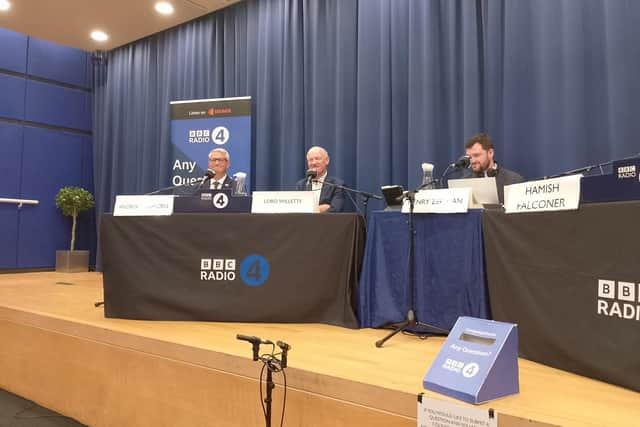
Once everyone was seated inside the lecture theatre, a representative from the Open University gave an introduction to the evening and explained the show had been invited to coincide with the 60th anniversary of the publication of the 1966 University of the Air white paper, which set out the vision for what would later become the Open University.
A BBC representative then said a few words about the programme, before the show’s producer came on stage and warmed up the audience, encouraging them to clap so the sound levels could be checked.
He then explained that no questions meant for fellow Radio Four programme Gardeners Question Time had been submitted by mistake (apparently this has happened before).
Places had been reserved on the front row for the audience members whose questions were selected.
Those audience members were then announced, and it was a pleasant surprise to learn my question had been selected to be asked first.
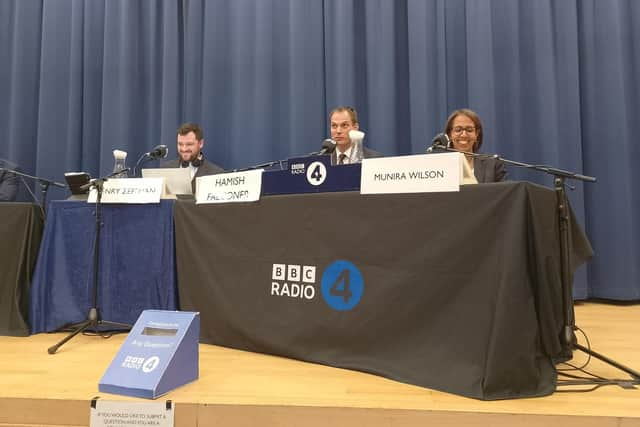
It gave me ten minutes to think about the fact I would be the second voice heard on the programme after stand-in presenter Henry Zeffman, the BBC’s chief political correspondent.
Henry and the panel, which consisted of Labour MP Hamish Falconer, Conservative peer Lord David Willetts, Liberal Democrat MP Munira Wilson and Reform UK MP Andrew Rosindell were then introduced on stage.
After the warm-up question, a feed of Radio Four came into the room just before 8pm allowing us to hear the famous pips, and the 8pm news bulletin, before the programme got underway.
Once the introductions had taken place, I asked the opening question, and the show was away for another episode.
The audience inside the theatre were encouraged to react during the programme, to give listeners a flavour of what they were thinking and feeling.
There was applause for comments made by all four speakers, with some receiving more than others.
There was some jeering, which may have come across on the live show, and was predominantly directed towards the Reform MP.
One thing that struck me listening to some episodes in advance, was compared to some political debate programmes, there was very little of people interrupting each other.
Watching things unfold from the front row, it was interesting how much hand signals were used - indicating who would speak, or to encourage the speaker to get to the end of their point, to either move the discussion on or bring someone else in.
The presenter’s job requires more multi-tasking than you would probably appreciate listening at home - as well as chairing the debate they use an iPad to communicate with the producer, predominantly about timings.
The programme is still available to listen to on BBC Sounds, and as well as the Government’s early release scheme, other topics covered were immigration, student loans and diversity, equity and inclusion in academia.
Questions six and seven never made it to air due to the show running out of time while question five got the final few minutes.
This was related to the climate and nature crisis and was posed by Judith Heinemann from the Milton Keynes Climate Action Network, who described the city as ‘dry as a bone.’
The debate continued the next day on BBC Radio Four’s companion programme Any Answers?, and surely would have done as the audience left the theatre, following an interesting evening of good-natured and robust discussion.