
Council pays out £5,000 in compensation for injuries caused by housing disrepair
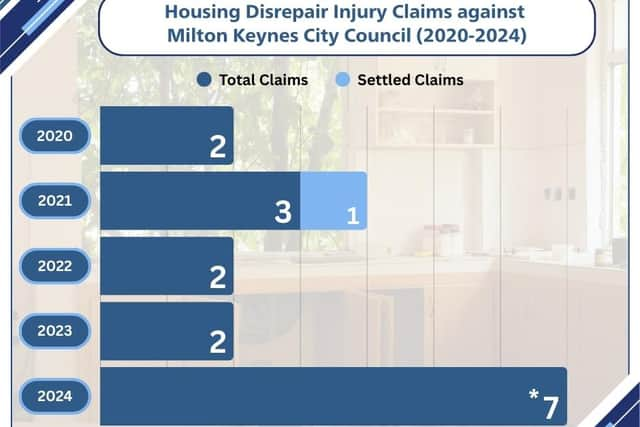
Over the past five years, 16 city tenants have lodged claims for injuries resulting from their council homes being in disrepair.
But just one of these claims has been settled with compensation – and this totalled £5,877.50.
The figures come from freedom of information requests submitted by JF Law, which supports tenants who have suffered injuries and illnesses due to housing disrepair and investigates whether they have grounds to submit a claim.
In Milton Keynes, such claims are increasing, with seven being lodged in 2024 alone.

The injuries can include respiratory conditions like asthma, which is worsened by damp and mould, or structural issues, faulty electrics and other hazards that can cause slips, trips or falls.
Examples include a roof leak causing a wet floor, which can lead to a slip and an occupant breaking a bone. Disrepair claims could also be caused by structural damage, such as broken staircases that eventually collapse and lead to serious injuries.
Illnesses can also be a product of housing disrepair. For example, a faulty heating system can cause to major health conditions as a result of the excess cold, which can also result in a person’s mental health being impacted.
In law, housing disrepair is classed as when a rented property poses a risk to the tenant’s health due to the need for certain repairs.
Under Section 11 of the Landlord and Tenant Act 1985, landlords have a responsibility to repair and maintain the exterior of the property, including windows and the roof, as well as sanitary fixtures such as plumbing, heating, hot water, and all electrical wiring.
The main causes for housing disrepair injury claims against Milton Keynes City Council include slips, trips and falls, which accounted for four claims and property damage, which led to three claims.
All residents should expect a house to be habitable, yet property damage can be present in various ways and can lead to serious injuries as well as health and safety risks, say JF Law experts.
They want to highlight the duty of care owed to council housing tenants and emphasise the importance of properly maintaining properties to prevent potential injuries and illnesses.
In April 2025, one of the country's largest housing associations was criticised for failing to tackle damp and mould after 95% of residents reported visible mould in their properties.
A report by the charity Medact was carried out into Peabody, which manages the Nags Head Estate in East London, and found that 36% of residents reported further disrepair in their homes, sometimes leading to injuries.
The most serious hazards in private rented homes, including mould, are estimated to cost the NHS £340m a year.
Also, the start of August, the BBC reported that thirteen children had died due to falling from windows in rented or temporary accommodation since 2019.
Many of these deaths were seen as “entirely preventable”, with landlords urged to fix faulty windows and ensure appropriate locks are in place. This is after four of the thirteen cases were caused by windows having no locks or restrictors.
JF Law operates a 24-hour helpline, along with an online claim form, which can be accessed here.