
Future of rubber gloves industry in the hands of Cranfield University boffins
Researchers at Cranfield University have developed a new method for 3D printing rubber gloves that is set to reshape the glove manufacturing industry.
Currently, glove manufacturing relies on huge production lines, making the process time-consuming, energy-intensive and resulting in a lot of synthetic material waste.
In contrast, the 3D printing method is more scalable and easier to tailor to smaller production quantities. It requires less space than a traditional full production line, and uses natural rubber which has the potential to offset the carbon emissions of the manufacturing process and biodegrade quickly.
“This is a novel manufacturing technique we’ve been developing and refining for some time in conjunction with our partners Meditech,” said Dr Eva Peláez-Álvarez, Research Fellow in Advanced Materials at Cranfield University.
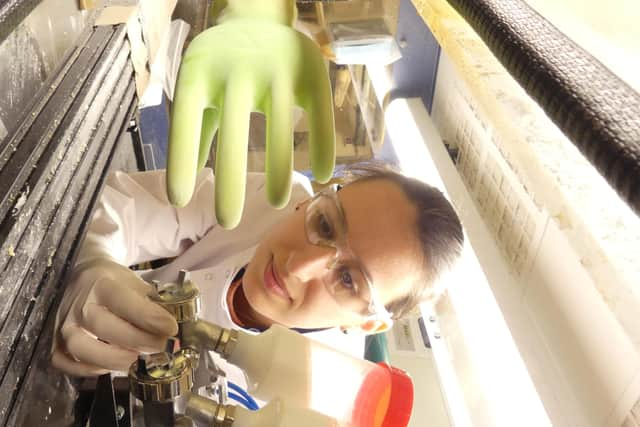

“There are so many benefits to migrating from traditional production line manufacturing to this type of 3D printing. Production is much more focused and customisable, and you can even scan people’s hands to make personalised gloves just for them. On top of all that you can do it more sustainably with less material wastage.”
Traditional glove manufacturing uses the dipping method, dipping gloves into multiple baths during the process, with the gloves needing time to dry between each step.
3D-PEP - the 3D printer for elastomeric products - instead sprays the rubber onto the mould, while simultaneously heating the glove from both inside and outside to vulcanise the gloves into the final product.
Manufacturing this way not only gives the ability to tailor the properties of the gloves, it also offer greater control over batch size.
Environmentally, using natural rubber latex for gloves is more sustainable than using synthetics.
The other positive comes at the end of life. Synthetic rubber gloves degrade over 100 times slower than natural rubber, and some types even need substances added before they can degrade at all. In contrast, natural rubber can degrade in a year and, given that billions of gloves are produced worldwide annually, that means significantly fewer damaging materials left in landfill.
“Now that we have proved this method in glove manufacturing, we’ll be looking into how it can be adapted for other industries as well,” added Dr Peláez-Álvarez. “There are plenty of other areas in which this method could be of benefit.”