
Investigation opens after train derailment near Milton Keynes which disrupted travel for days
An investigation has opened into a train derailment last month which caused disruption for passengers travelling in and out of Milton Keynes for several days.
The Rail Accident Investigation branch is now examining the incident, which took place just before 12.30pm on Thursday June 26.
Railway news website RailAdvent reported that the derailment occurred at the Denbigh Hall South junction on the West Coast Main Line when the front bogie, a structure underneath a railway vehicle to which axles are attached through bearings, became derailed.
The train, which was not carrying any passengers at the time of the incident, was estimated to be travelled at 15 miles per hour on the slow line from Bletchley station.
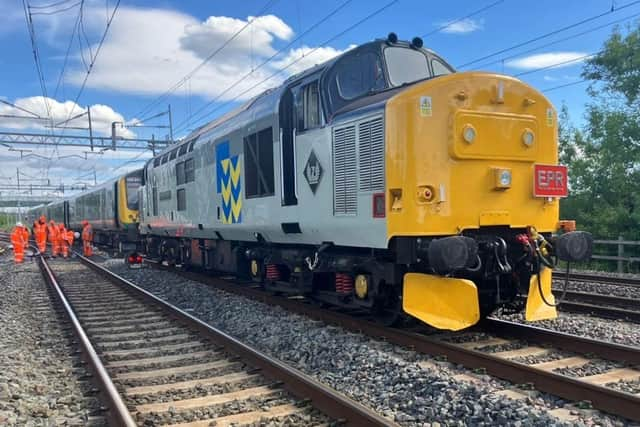

The front bogie became derailed on a switch diamond crossing, and was not recovered until the following day.
Work to assess the damage and complete repairs lead to the closure of some lines through the junction until the afternoon of Sunday June 29, with commuters journeys disrupted into June 30.
Four members of staff were on the train at the time, but no injuries were reported.
The train had suffered a technical problem earlier in the day, according to RailAdvent, and had been unable to depart southwards towards platform four at Bletchley.
It was able to be driven northwards, allowing it to be moved clear of the platform, however there was only one signalled route from the north end of the platform, previously occupied by a failed on-track machine.
It is claimed that staff at Rugby then allowed the train to travel in the wrong direction on the southbound line.
This required the signaller to instruct the driver to bypass the north end platform signal and travel to Denbigh Hall South junction without the protection of interlocking, a process which is designed to prevent conflicting movements at junctions or crossings.
The intention at Denbigh Hall South was for the train to cross on to the slow line where it would be back under normal signal control, before continuing northwards towards Northampton.
The Rail Accident Investigation branch will look at the events prior to the derailment, including the actions of those involved, how unscheduled movements were determined and validated, the management arrangements for staff involved in the accident and any other factors that could have contributed to the derailment.