
How much does it actually cost to buy car parts without getting advice from a specialist?


Most drivers learn about car parts the hard way by ordering the wrong component twice. Consulting a specialist can prevent these costly mistakes, saving time and money on returns, shipping, and potential vehicle damage.
The online automotive parts market has grown rapidly and complexity has not decreased. Modern vehicles use dozens of different specifications for seemingly identical components. For example, a brake pad for a 2018 Ford Focus might have eight different specifications depending on the exact model variant. Without guidance, drivers often purchase parts that fit physically but perform poorly or worse, buy items that don't fit at all. Expert support can be the difference between a £200 mistake and £40 well spent.
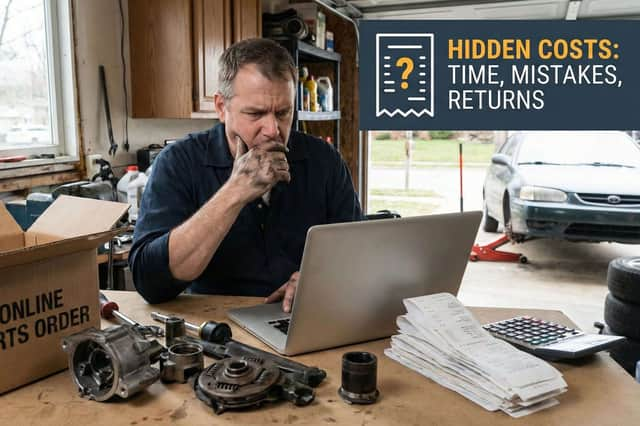
Imagine this scenario: you’ve diagnosed a brake problem, ordered new brake discs based on your car's year and model, and waited three days for them to be delivered. The package arrives, you jack up the car, remove the wheel, and discover that the discs are the wrong diameter. Your vehicle is undriveable while you arrange a return and wait another week for the correct parts. In the meantime, you have to pay for taxis or a hire car.
This scenario plays out thousands of times a day across the UK. It's not just the inconvenience that's the problem; it's the cascade of costs that follow. Misdiagnosing issues can lead to buying parts that don't solve the actual problem. For example, what seems like a battery issue could actually be a failing alternator. A rough idle could be caused by spark plugs, ignition coils, fuel injectors, or a vacuum leak.
Then there's the compatibility maze to navigate. Engine variants, production dates, and regional specifications all determine whether a part fits. You may also require mounting hardware, gaskets or specialised tools that aren't included or mentioned in the listing.
AUTODOC, a major European online car parts retailer, encounters these challenges daily. That's why they've built an extensive customer support infrastructure to handle the technical nature of automotive products. A quick call or chat with their specialists can cross-reference VIN numbers, verify compatibility, and highlight any prerequisites before placing an order.
Understanding driver needs through research
So, what do drivers actually know about maintaining their cars? In November 2025, AUTODOC ran a survey to find out, and the results paint an interesting picture of British driving habits.
Start with the basics: what's the first thing you do before driving? Nearly half (44%) adjust the mirrors and seat position, while 18% fasten their seatbelt straight away. Another 21% check the fuel level, probably because they’ve run out of petrol before. Surprisingly, 18% admit to checking their music playlist first, which says something about modern driving priorities. While some of these are good habits, they're just the beginning of proper vehicle care.
Tyre pressure tells a more concerning story. While 45% do check them monthly as recommended, 15% only check them when a warning light appears. By then, you've already been driving on under-inflated tyres for weeks or even months. This reduces fuel efficiency, causes uneven tread wear, and can even lead to blowouts at motorway speeds. Another 34% check their tyres before long trips, which is better than nothing, but still leaves gaps. The 6% who never check their tyre pressure are taking unnecessary risks every time they drive.
Coolant checks show better awareness: 54% of people check regularly. However, 5% never check it at all. This is like playing Russian roulette with your engine. A £5 coolant top-up can prevent overheating damage that could cost £2,000 to repair. Another 23% only check before long trips and 18% wait for service intervals. The problem? Coolant leaks don't wait for convenient timing.
Battery maintenance reveals the most reactive behaviour. Only 27% check their battery's condition before winter, even though most batteries fail in cold weather. An astonishing 35% wait until the car won't start. Imagine discovering your battery is dead when you're already late for an important meeting or rushing to the airport. Another 25% check their battery once a year, while 12% never check it at all.
Handling thousands of customer inquiries daily while maintaining quality isn't cheap. It requires serious investment in training, technology, and logistics.
AUTODOC's Chief Strategy Officer, Lennart Schmidt, recently shared the company's Q3 2025 results, which tell an interesting story about scaling customer support. Sales revenue reached €1.33 billion, marking a 17% year-on-year increase, and the company now has over 9 million active customers across Europe.
However, revenue growth alone does not improve customer service. What matters is how that money is spent. AUTODOC has been expanding its Marketplace platform to give customers access to a broader range of products while maintaining quality standards. Its PRO division now serves over 30,000 garages across Europe. This is not just about B2B sales: these garages provide valuable insights into common issues, installation peculiarities, and part performance, which are fed back into customer support.
The Belgian supply chain hub deserves special mention. With multiple warehouse locations in Berlin, Szczecin, Cheb, and Ghent, deliveries are faster and the supply chain is more resilient to disruption. When customers call with queries about delivery times or alternative options for out-of-stock items, support specialists can provide accurate responses because the infrastructure is effective.
This matters more than it might seem. A support team overwhelmed by logistical issues cannot focus on helping customers choose the right parts. However, when deliveries run smoothly and stock levels are reliable, these same specialists can dedicate their time to activities that add value, such as providing technical guidance, conducting compatibility checks, and solving problems.
Empowering drivers through education
The best support doesn't just react to problems; it prevents them from arising in the first place. Leading companies are increasingly using multiple channels to share knowledge and gain insight into what information their customers actually need.
Take AUTODOC’s YouTube channel, for example. As well as product videos, they run community polls on topics such as driving abroad. A recent poll found that 42% of drivers read up in advance using apps or videos before international trips. That's almost half of their audience actively seeking information before problems arise.
This changes the dynamic entirely. Rather than waiting for confusion or mistakes to occur, drivers can access reliable information during the research phase. Tutorial videos demonstrate installation procedures step by step. Articles explain technical specifications in plain English. Comparison guides help them to choose between premium and budget options.
The feedback loop works both ways. For example, if hundreds of people ask the same question about brake pad compatibility for a specific vehicle, this suggests the need for a detailed buying guide. If customers repeatedly struggle with a particular installation, this suggests that a tutorial video would be helpful. Support teams use these patterns to develop resources that reduce future enquiries and genuinely help customers to make better decisions independently.
Different people learn in different ways. Some prefer written guides that they can refer to while working under the car. Others want video demonstrations that they can watch on their phone in the garage. Some people just need a quick chat to confirm that they are on the right track. Providing expertise in various formats means more people can access the help they need; however they prefer to receive it.
The unsung value of expert advice
When a driver thanks a support specialist, they are acknowledging the real value of the advice they have received. It's not just politeness; it's genuine appreciation for money saved, time not wasted and frustration avoided.
Consider what that consultation prevented: incorrect parts gathering dust, return shipping costs, days without a car, emergency taxi fares, and the stress of disrupted plans. One conversation could save £50 on a single order, but over the course of years of vehicle ownership, the cumulative benefit could amount to hundreds of pounds.
Companies that invest in quality support infrastructure, the systems, training and operational excellence required to consistently deliver helpful advice, ultimately serve their customers better. In automotive maintenance, where complexity meets necessity and mistakes can be costly, reliable expertise is essential. It's the difference between a smooth repair and a costly mess.
The business model is straightforward: help customers get it right the first time and they will come back. Cut corners on support to save costs and you will end up spending more on managing returns, complaints, and lost customers. Companies that recognise this and invest in both technology and human expertise are building something more valuable than transaction volumes. They're building trust.
Looking to save on car parts? We’ve secured an exclusive deal for you. Use the code ATD7LW99 to enjoy a 5% discount on your next AUTODOC order. Don't miss out—this code is valid until 14 February 2026.