
Sheer volume of water causes unusual situation of lake merging with river in Milton Keynes
Heavy recent rainfall has caused a highly unusual ‘hydrological happening’ in Milton Keynes – a lake merging with a river.
Bradwell Lake has is almost completely connected with the River Great Ouse due to the sheer volume of water, The Parks Trust has revealed this week.
The good news is that when still water in a lake merges with river systems temporarily, they create a super‑habitat, allowing fish to move between slow and fast water and creating an ecologically rich event, say the Trust’s experts.
But the bad news is that the area must be treated with extreme caution by humans, particularly anglers.
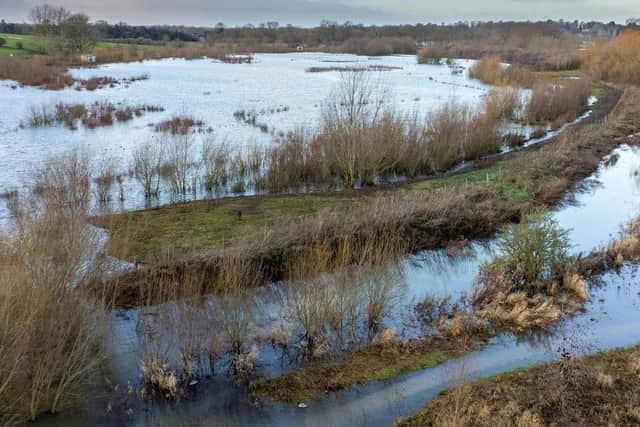

The area affected is the Floodplain Nature Reserve at Wolverton, former pasture land that was quarried between 2007 and 2014 for sand and gravel. It was afterwards transformed into a huge nature reserve of wetlands, which are rich in wildlife as well as rare birds and plants.
AParks Trust spokesperson said: “Last week’s ice has disappeared, but the heavy rainfall has dramatically reshaped the floodplain. The River Great Ouse is running unusually high and fast, pushing water deep into surrounding meadows. Ground conditions are unstable, with familiar paths and banks now underwater or softened by saturation.”
They added: “If you’re fishing the margins, banks may be submerged and the apparent water’s edge may sit over soft, newly saturated ground. Test every step — the ground can give way unexpectedly.”
The Parks Trust describes the current merging of the floodplain lake and the river as an “ecologically rich event” and are advising people not to visit the area while the water is so high. Updates on the current flooding status are available here.
Meanwhile the Wetland Arc Project is officially underway at the floodplain site. A two‑year masterplan led by The Parks Trust, it spans 355 hectares of wetlands, lakes, and floodplain meadows along the northern edge of Milton Keynes, including Stony Stratford Nature Reserve, Ouse Valley Park, , Stanton Low, and Linford Lakes. The project has been kickstarted with a £213,000 National Lottery Heritage Fund grant, supporting habitat improvements, access upgrades, and long‑term planning for nature recovery.
.