
Roads designated for 'tram-like' vehicles and more signalised roundabouts - this will be Milton Keynes in 2050
A glimpse into how people will get around MK in the future has come this week as the council’s official Local Transport Plan 5 goes out for public consultation.
The document, which can be viewed here, sets out all the transport aspirations for the city for the next 25 years.
By far the biggest proposal is the introduction of a new Mass Rapid Transit System (MRT) which could be started in as little as five years’ time.
It will be a high quality tram-like system using rubber-tyred vehicles with boarding platforms on designated lanes on our grid roads.
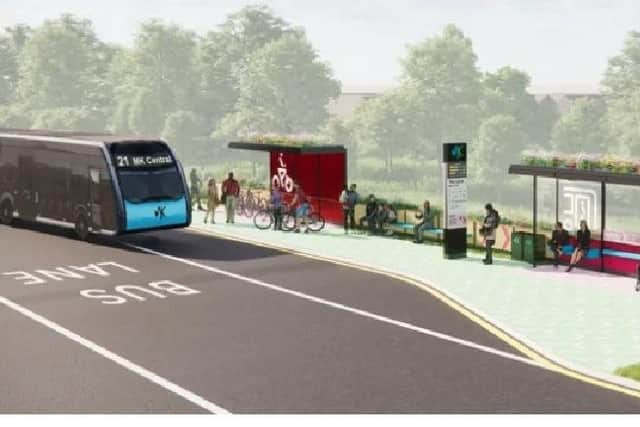
And the system has even been given a name – MK Metro – which will bring back memories for many people of one of the city’s first bus services in the 1980s.
The plan document states: "Journey times are critical, so we will need to allocate dedicated road space in theform of reserved bus lanes to ensure that the public transport vehicles are protected from congestion and general traffic. This means there will be less road space available for cars in some places across the network, but in MK we have the advantage of numerous parallel route alternatives, thanks to our unique grid system.”
It adds: “This would deliver a ‘MK Metro’ service across the city region on 5 key routes. The routes are being developed to serve both existing residential and employment areas, but also to help unlock new development sites.
"This would be our primary, or top-level, high frequency, high quality public transport service.”
The plan also highlights the need to make walking and cycling more attractive, but admits many residents feel unsafe using the 350km Redway network due to poor lighting, overgrown plants, and dark underpasses.
It points out the massive increase in car use since MK was designed decades ago and aims to encourage more people to use alternative trabsport.
For those choosing to use cars, the news is not good. For the plan proposes raising parking charges in CMK for the third year in a row, stating it’s “an acceptable trade-off” for those who can afford the extra cost.
Opposition Conservative councillors have slammed this, saying it risks hitting lower-income drivers the hardest, while the promised alternatives like
improved buses and the new MK Metro are still years away from being ready.
Finally the plan proposes more traffic signals on our roundabouts in MK – though not all 132 of them.
It states: “None of our roundabouts were signalised to begin with – traffic flows did not require it in the early days of the city’s existence. But, as traffic has progressively grown, our roundabouts have ‘failed’, and signals have had to be introduced in order to manage congestion and delays.
“This approach will be needed more and more, which may not be favoured by some residents, so we will defer their introduction for as long as we can. However, the simple fact is that roundabouts don’t work very well with heavy traffic flows, or with a predominant traffic flow along a single axis (eg where a main road, such as the A509 or A421 passes through them) and we will need to address this as our traffic increases – either through roundabout enlargement or the introduction of traffic signal schemes.
"We certainly won’t enlarge or signalise all 132 of the larger ones, but there will be a need for an increasing number of our major grid road junctions to be improved if our city is to grow without detrimental highway impacts on those who already live and work here.”
Conservative councillors say the ideas in the plan may sound appealing, but history shows delivery often falls short — and in the meantime, residents face higher costs and fewer parking spaces.
Cllr Shazna Muzammil-Cook, leader of the Conservative Group, said: “We will always stand on the side of residents — the parents doing the school run, the
shift worker getting home after midnight, the carer rushing between appointments. Residents deserve want and deserve transport plan that works in reality , not an uncosted wishlist.”
The public consultation will run for 12 weeks and will start next month.